Macquarie University Researchers Seeking Assistance from Chinese-speaking Caregivers of People with Dementia
The SOLACE (Social Isolation, Loneliness, and Cultural Experiences) Project
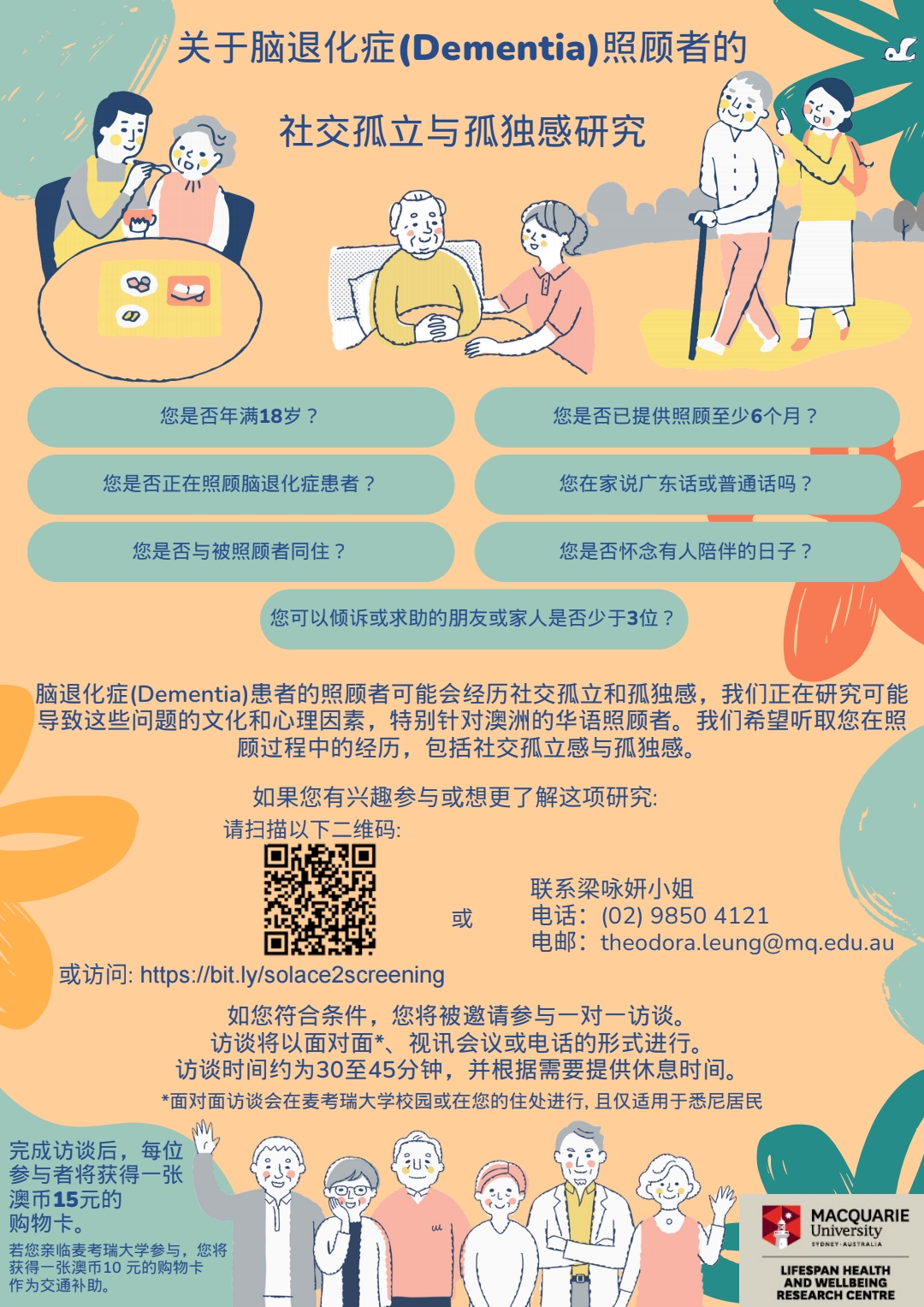
Researchers at Macquarie University are currently exploring the cultural and psychological factors that may cause and maintain social isolation and loneliness among Chinese-speaking caregivers of people with dementia in Australia. We would like to invite Mandarin- or Cantonese-speaking caregivers aged 18 years and over, live with the person with dementia, have provided care for at least six months, with feeling of socially isolated and/or lonely to participate in a one-on-one interview and sharing their experiences of social isolation, loneliness and being a caregiver. Your research participation benefits the community by helping us to understand social isolation and loneliness in Chinese-speaking caregivers of people with dementia and inform the development of support and/or treatments for this group.
Join us in learning how Australian democracy works, how to participate in Australia’s democratic process and how to identify misinformation and disinformation.
Co-organised by CCCAV (The Chinese Community Council of Australia, Victoria Chapter) and CPCA (Chinese Professionals Club of Australia).
This workshop is a Chinese Australian Forum CAF initiative, supported by the Australian Government’s National Foundation for Australia-China Relations.
Presented by Dr Eric Fu (Senior Research Fellow – Civics and Citizenship Education, Youth Social and Political Participation) from the University of Melbourne.
Workshop will be filmed. You have the option to indicate should you not wish to be filmed within the booking form.
Venue: Clayton Community Centre – Theatre. 9-15 Cooke Street, Clayton, Victoria 3168.
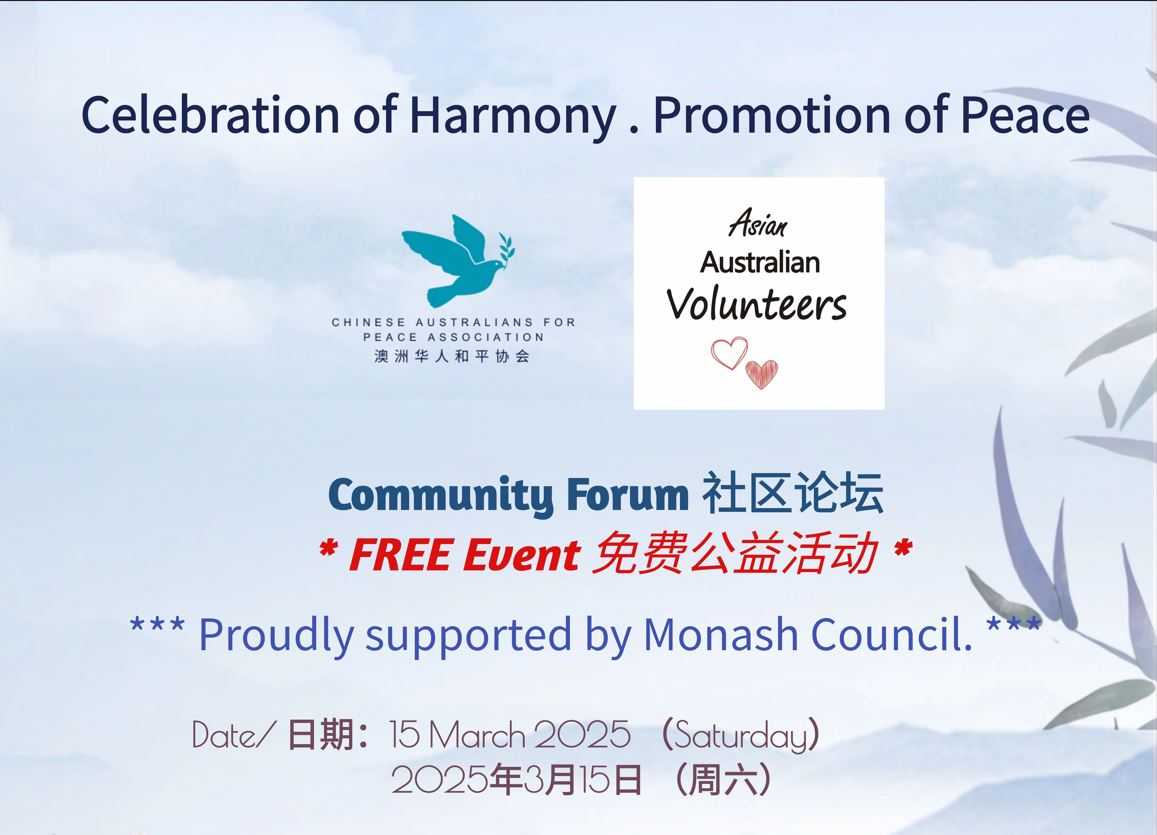
Theme: As we commemorate the 80th anniversary of the end of World War II across the Asia-Pacific, Europe, and beyond, this milestone provides a poignant opportunity to reflect on the devastating experiences of the war—widespread destruction, immense loss of life, and profound human suffering—and the lessons we should learn to prevent future conflicts, promote peace, and strengthen understanding and social cohesion in today’s multicultural societies.
Keynote speakers:
Professor Yuki Tanaka (田中利幸教授)
Yuki Tanaka was a research professor at the Hiroshima Peace Institute, Hiroshima City University, until his retirement in 2015. He was a visiting professor at Birkbeck College, University of London, UK, and the Sir Ninian Stephen Visiting Scholar at the Law School, University of Melbourne, Australia. His publications include 《Entwined Atrocities: New Insights into the U.S.- Japan Alliance (2023)》; 《Hidden Horrors: Japanese War Crimes in World War II (second edition 2018)》; 《Japan’s Comfort Women: Sexual Slavery and Prostitution During World War II and the US Occupation (2002)》; and the co-edited collection 《Beyond Victor’s Justice? The Tokyo War Crimes Trial Revisited (2011)》. He has also published many books in Japanese. He lives in Melbourne and works as a freelance historian.
Dr Jun (Eric) Fu (付俊博士)
Dr Jun (Eric) Fu is a Senior Research Fellow at the Youth Research Centre, Faculty of Education, University of Melbourne. He has been doing citizenship education and research for more than ten years. His research interests include digital media, citizenship practices of young people, and media and digital literacy education. He has published in journals and edited book collections in the field of youth studies and citizenship education.
Taewoo Kim
“I’m Taewoo Kim, the president of Friends of Comfort Women in Melbourne (FCWM). Since taking on this role, I’ve worked with our group to build stronger connections with other non-governmental organizations. We’ve set up stalls at events like the Korean Festival in Melbourne, where we raise awareness about the peace statue and highlight the war crimes committed against women. My goal is to continue the legacy of the “Halmeonies” by collaborating with groups like CAPA to keep pushing for justice and remembrance.”
Christine Kim
Christine Kim is the secretary of Friends of “Comfort Women” in Melbourne (FCWM) and has been actively participating in the justice movement since 2017. Outside of her volunteering, Christine works for Monash University as an in-house lawyer.
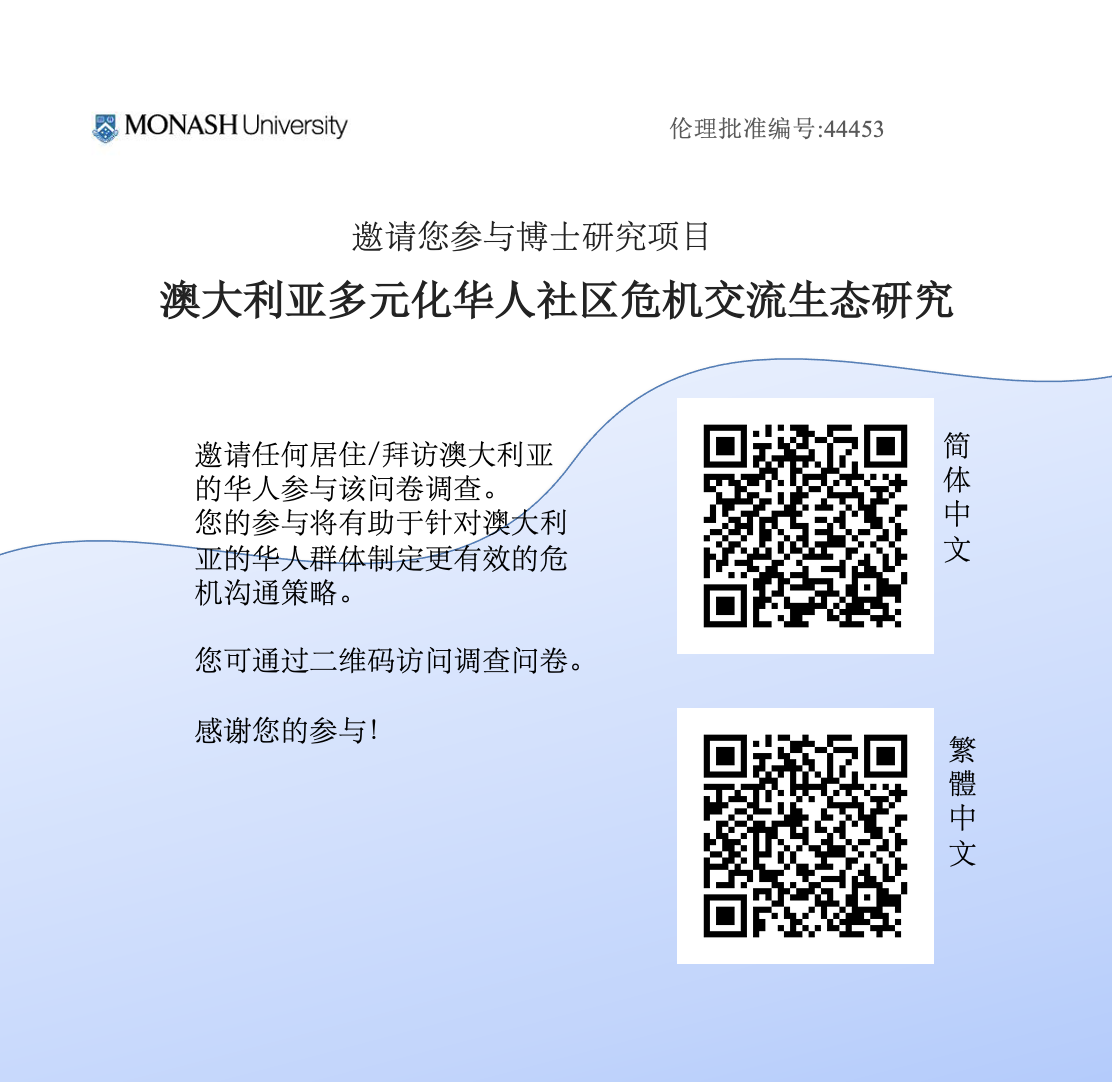
The survey welcomes anyone who identifies as having Chinese ancestry and are staying or living in Australia. Your participation will help develop more effective communication strategies with Chinese-Australian communities in crisis situations, and help the communities to be safer.
You will be asked about your (1) demographic information, (2) crisis experience, (3) crisis communication habits and (4) crisis actions. The survey will take about 10 minutes to complete and can be accessed in English, Simplified Chinese, and Traditional Chinese, with audio support.
Please find more information of the research in the introduction page of the survey. Feel free to contact at Shuangming.Huang@monash.edu if you have any questions.
Thank you for your time and support!
Survey link: English version https://monash.az1.qualtrics.com/jfe/form/SV_3kK4vDiIUo3hyCi
Congratulations to Annisa Li Zhang (张俪), Wesa Wai-Sum Chau (邹慧心), and Jijun (Jack) Yang (杨际军) on their well-deserved induction into the Victorian Multicultural Honour Roll! This prestigious recognition honours their outstanding contributions to multiculturalism in Victoria.
The induction ceremony, held on 4 December 2024, at the iconic Government House, was hosted by Her Excellency Professor the Honourable Margaret Gardner AC, Governor of Victoria. The event was also attended by Premier Jacinta Allan, Minister for Multicultural Affairs Ingrid Stitt, and VMC Chairperson Vivienne Nguyen.
This achievement is a testament to their dedication and hard work in promoting diversity and inclusion in Victorian communities.
Annisa Li Zhang is a dedicated advocate for multiculturalism in Victoria, making significant contributions through her leadership roles, community work, and writings. She authored and published a groundbreaking 350-page book, In the Town Hall, which chronicles her experiences as a local candidate during the tumultuous period of the COVID-19 pandemic and her resilience in the face of racial online attacks. Establishing the Asian Leadership Program, Asian-Australians are empowered with the essential knowledge, skills, networks, and confidence to assume leadership positions in politics.
Annisa has been a tireless advocate for multicultural communities, championing various initiatives, particularly in the arts and festivals. A standout achievement is her successful proposal and implementation of Glen Eira’s first official Lunar New Year celebration in 2022. She also played a key role in establishing Glen Eira’s first Multicultural Advisory Committee, serving as its co-chair. She has demonstrated her commitment to community engagement and social cohesion by organising teams to participate in the AFL Unity Cup program.
Wesa Wai-Sum Chau:
Wesa Chau is one of Australia’s most influential voices and foremost thought leaders on multiculturalism and cultural diversity. She is currently the Managing Director of Multicultural Leadership Initiative, a national non-profit organisation that aims to uplift the voices of culturally and linguistically diverse people to shape solutions address climate change.
Wesa has been recognised through numerous awards such as the 40 Under 40 Most Influential Asian-Australian Awards in 2020 as the category winner in education, an Australian Leadership Award in 2013, the Young Victorian of the Year Award in 2010, and was an inductee to the Victorian Honour Roll of Women in 2012.
Jijun (Jack) Yang:
Born in Longxi County, China, Jijun (Jack) Yang immigrated to Ballarat and has established himself as a vital community member volunteering his time offering free tai chi classes in the beautiful surrounds of Lake Wendouree. His outgoing personality, communication skills and sense of energetic improvement has attracted a diverse group of followers to attend his classes from primary school children to senior residents.
Jack also teaches at the English Corner Group encouraging cultural exchange through song and performance whilst migrants learn English. He demonstrates and teaches tai chi for the Ageing Well program of Ballarat City Council and at local events and community clubs in the area. He supports Ballarat Regional Multicultural Council’s multicultural events as well as local associations promoting Chinese culture and practice at aged care facilities, schools and sports groups.
The holiday season is a great time to connect with family and friends and to take a vacation. When you go out, please drive safely and within the speed limit.
Speeding puts everyone in danger, and you may face serious penalties for speeding.
Police will be around to ensure everyone follows the road rules.
To keep everyone safe, please slow down. The Chinese Community Council of Australia, Victoria Chapter (CCCAV) wishes you a happy holiday season!