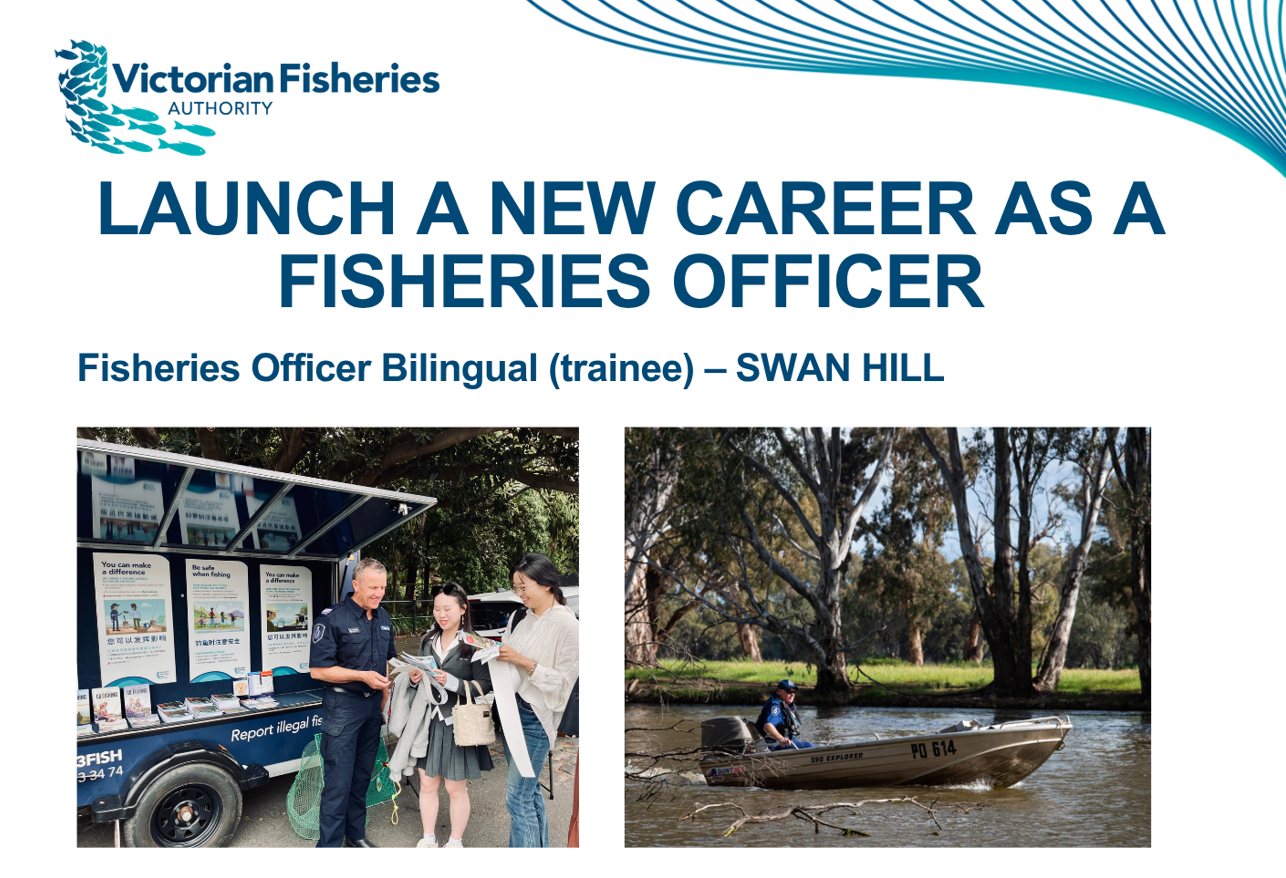
Bilingual Job Opportunity for Vietnamese and/or Chinese Speakers: Fisheries Officer Trainee
Do you speak Vietnamese and/or Chinese and want a meaningful government career serving the community? The Fisheries Officer (Bilingual Trainee) role in Swan Hill is a great opportunity to use your language skills to engage with diverse fishing communities, promote compliance, and help protect Victoria’s fisheries. This paid traineeship provides structured training, hands‑on experience, and a strong entry point into a public service career.
Applications close at 23:59pm on Tuesday, 5 May 2026.
你会说越南语和/或中文,并希望从事一份服务社区的政府工作吗?位于 Swan Hill 的双语见习渔业监管官(Fisheries Officer, Bilingual Trainee)岗位,为你提供一个运用语言优势、与多元文化社区交流、推动守法意识并共同保护维多利亚州渔业资源的良好机会。该岗位为带薪见习职位,提供系统培训和实践经验,是进入公共服务领域的一个稳健起点。
Lifeline Support Toolkit: Practical Resources for Mental Wellbeing
Lifeline’s online Support Toolkit offers practical, easy‑to‑use resources to help people navigate difficult moments and support their mental wellbeing.
Designed for individuals, families, and communities, the toolkit provides guidance on understanding emotions, managing stress, and exploring coping strategies at your own pace. It also helps you recognise when extra support may be needed and how to reach out safely and confidently.
The Support Toolkit is confidential, free, and accessible online—making it a helpful first step for anyone seeking support, or for those looking to better support others during challenging times.
The toolkit can also be viewed in Chinese by clicking the “Translate” button at the top right of the page. Please note that this translation is generated automatically and may not be fully accurate.
International Women’s Day Forum Highlights Women’s Voices in War, Memory, and PeaceBuilding
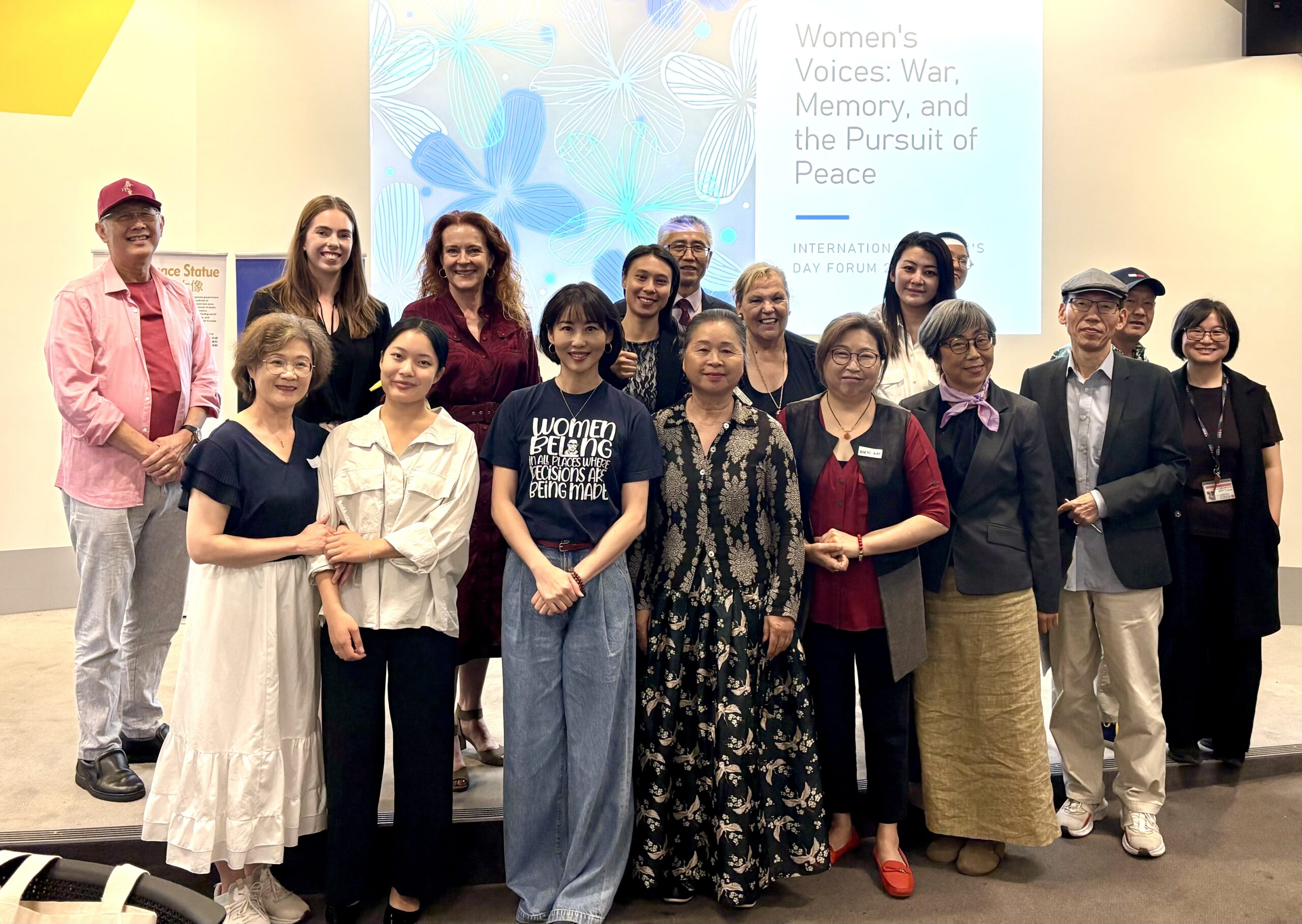
Community leaders, scholars, artists and members of the public gathered at RMIT University on Saturday 7 March for the 2026 International Women’s Day Forum: Women’s Voices in War, Memory, and The Pursuit of Peace. The forum focused on women’s experiences of conflict, historical memory, and peace‑building.
The forum opened with an Acknowledgement of Country by Associate Professor Dr Jing Qi, followed by welcoming remarks from Dr Jimmy Li. Dr Li emphasised that peace should not be understood as a settled historical achievement, but as an ongoing process—one that must be actively renewed through education, dialogue, and honest remembrance. He highlighted the importance of listening to women’s voices, noting that women’s experiences of war have too often been marginalised or silenced.
Deputy Mayor Cr Li Zhang of the City of Glen Eira spoke about the significance of International Women’s Day as both a celebration of women’s leadership and a reminder of persistent global inequalities. She noted that women and girls often bear the greatest impact of war and violence, and emphasised that preserving women’s stories with dignity is essential to building understanding and promoting peace. Cr Zhang also highlighted the role of community forums in fostering intergenerational learning and dialogue within multicultural communities.
Cr Gladys Liu of the City of Melbourne spoke about the City’s commitment to inclusivity and respectful community engagement. She said that while history cannot be changed, it must be learned from, particularly to ensure that women and children are not going to suffer.
The forum featured a series of presentations examining women’s testimony and memory. Professor Yuki Tanaka spoke on Sharing Pain Generates Hope, recounting the story of atomic bomb survivor Suzuko Numata, who reflected on shared suffering and renewal through the image of a wounded yet surviving paulownia tree. Professor Gil‑Soo Han examined The Kim Bok‑dong Legacy, highlighting the lasting influence of the late survivor‑activist’s advocacy and calling for dignity and justice not only through historical recognition, but also in everyday life.
Christine Kim, President of the Alliance for Peace and Memory, spoke on The Power of Voice, sharing the story of Kim Hak‑sun, whose public testimony broke decades of silence around wartime sexual violence and became a turning point in global awareness and advocacy. Author Georgina Banks presented the story of her great‑aunt Dorothy “Bud” Gwendoline Howard Elmes, drawing attention to the Bangka Island massacre in WWII and the importance of truth‑telling in addressing long‑silenced histories.
Musical performances by Stephanie Chen on flute and Young Rang Kim on gayageum created powerful moments of reflection, complementing the forum’s themes of remembrance and resilience.
A panel discussion and Q&A explored how younger generations—many without direct experience of war—can engage meaningfully with histories of conflict. Speakers emphasised that education, storytelling and the arts play a vital role in preserving historical memory, and that peace‑building and respect for women begin in everyday life.
Co‑hosted by the Alliance for Peace and Memory, Chinese Australians for Peace Association, Friends of “Comfort Women” in Melbourne, Asian Australian Volunteers, and the Chinese Australian Studies Forum at RMIT, the forum reaffirmed a shared commitment to honour women’s voices, remember truthfully, and work collectively toward peace.
(By Organising Committee for the 2026 International Women’s Day Forum: Women’s Voices in War, Memory, and The Pursuit of Peace)
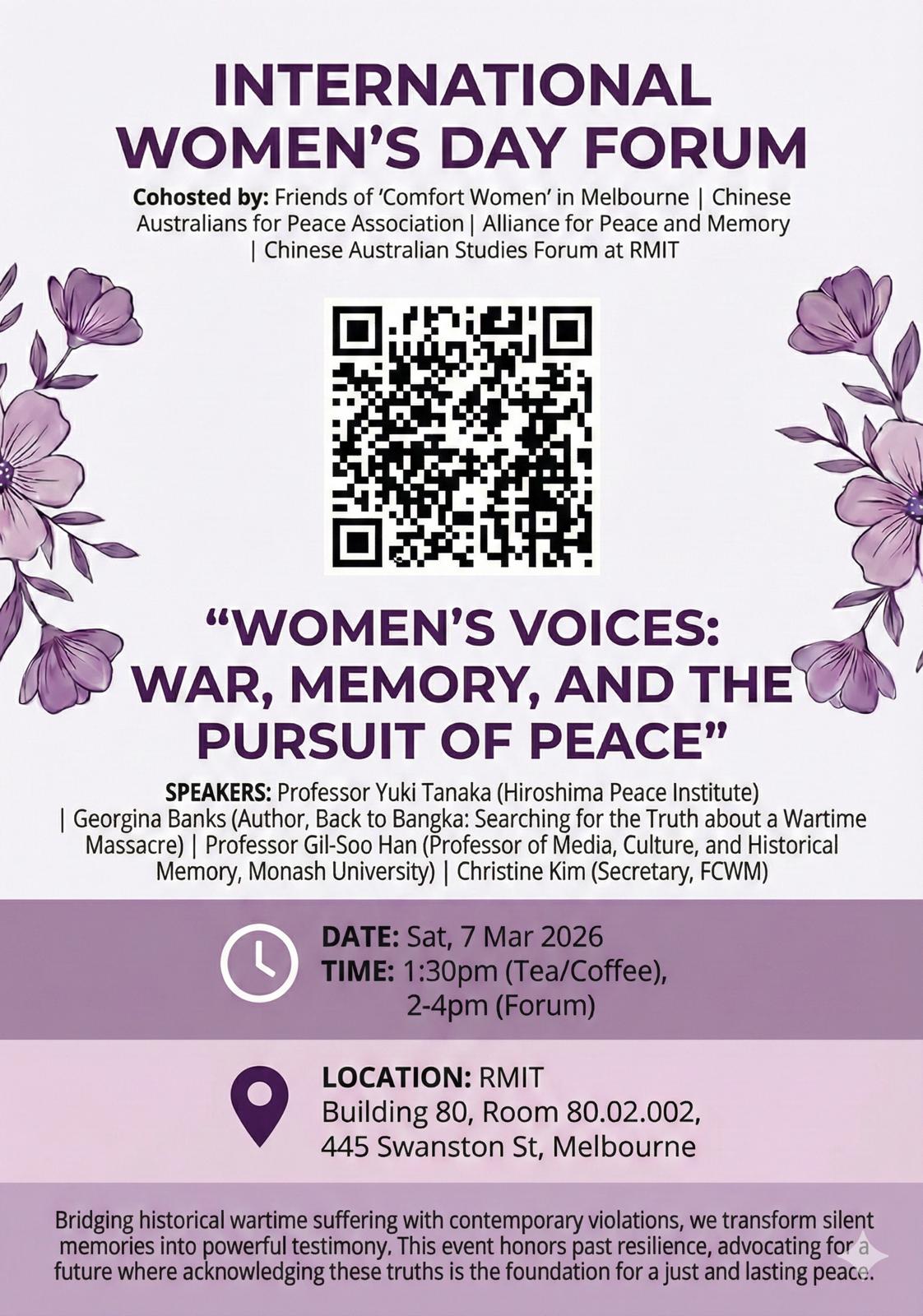
2026 International Women’s Day Forum – Women’s Voices: War, Memory, and the Pursuit of Peace
The forum brings together historians, authors, scholars, and community advocates to explore how women experience war, how violence and injustice are remembered, denied, or silenced, and why truthful remembrance is essential to dignity, justice, and peace.
Date: Saturday 7 March 2026, 1:30PM for 2:00PM-4:00PM
Co-hosted by: * Alliance for Peace and Memory * Chinese Australians for Peace Association * Friends of “Comfort Women” in Melbourne * Chinese Australian Studies Forum at RMIT * Asian Australian Volunteers
Speakers:
* Professor Yuki Tanaka Historian Professor Yuki Tanaka is a historian whose work focuses on war, violence, and historical responsibility in the Asia–Pacific region. A former Research Professor at the Hiroshima Peace Institute, he has written extensively on war crimes, civilian suffering, and wartime sexual violence, including influential studies on the Japanese military “comfort women” system and the politics of historical memory and accountability.
* Georgina Banks Author, Back to Bangka: Searching for the Truth about a Wartime Massacre Georgina Banks is the author of Back to Bangka, a non-fiction work that investigates the 1942 Bangka Island massacre of Australian Army nurses through family history, archival research, and personal reflection. Published in 2023, the book explores silence, intergenerational memory, and the long search for truth surrounding women’s experiences of wartime violence.
* Professor Gil-Soo Han Scholar of Media, Culture, and Historical Memory Professor Gil Soo Han is a Professor at Monash University whose research examines media, nationalism, and historical memory, particularly in East Asia. His work explores how histories of conflict and injustice are represented and contested in public discourse, and how collective memory shapes dignity, reconciliation, and peace.
* Christine Kim President, Alliance for Peace and Memory; Secretary, Friends of “Comfort Women” in Melbourne Christine Kim is the Secretary of Friends of “Comfort Women” in Melbourne, a community organisation dedicated to remembrance, education, and advocacy for justice for women subjected to sexual violence during war. Her advocacy work centres on survivor dignity, intergenerational memory, and the role of public remembrance in promoting human rights and peace.
Congratulations on the Opening of the Museum of Chinese in Australia (MOCA) in Sydney
祝贺澳大利亚华人博物馆(MOCA)在悉尼正式开放
CCCAV warmly congratulates the Museum of Chinese in Australia (MOCA) on its official opening on 22 February 2026 in Sydney.
As reported by SBS, the launch of MOCA marks a significant milestone in preserving and sharing the rich history, culture and lived experiences of Chinese communities in Australia. Brought to life in the Year of the Fire Horse, the museum stands as a powerful symbol of resilience, renewal and cultural pride.
MOCA provides an important space for storytelling, education and reflection, ensuring that the contributions of Chinese Australians are recognised as an integral part of Australia’s shared history. CCCAV welcomes this important addition to Australia’s cultural landscape and looks forward to the positive impact the museum will have on future generations.
We extend our congratulations to everyone involved in making this vision a reality.
Congratulations to Professor Kelvin Kong AM on His 2026 Wang Gungwu Lecture and Powerful Reflections on Chinese and Indigenous Identity
祝贺 Kelvin Kong AM (江启文) 教授荣膺2026年度王赓武讲座(Wang Gungwu Lecture)主讲人,并就华人身份与原住民身份发表深刻而有力的反思与分享
We congratulate Professor Kelvin Kong AM on his moving speech at the 2026 Wang Gungwu Lecture, where he shared reflections on growing up Chinese and Indigenous in Australia, as featured by ABC News on 11 February 2026.
A proud Worimi man of Malaysian‑Chinese heritage and Australia’s first identified First Nations surgeon, Professor Kong spoke about identity, belonging, and the lived experience of navigating multiple cultures. His address also highlighted the often‑overlooked history of Chinese–Aboriginal communities, many of which trace their roots back to the 19th‑century gold‑rush era and continue across generations today.
Delivered at Parliament House as part of one of Australia’s most significant forums on Chinese diaspora and Australia–China relations, the Wang Gungwu Lecture placed Professor Kong’s story on a national stage—underscoring how shared histories enrich our understanding of Australia’s multicultural and First Nations narratives.
Caregiving Experiences Survey for Caregivers of People Living With Dementia
脑退化症者照护者的照护经验调查
Researchers at Macquarie University are studying the caregiving, social experiences, and wellbeing among English-speaking and Chinese-speaking family caregivers of people with dementia in Australia.
We sincerely invite carers who meet the following criteria to participate in this survey study:
• Aged 18 years or above
• Have been providing care to a family member with dementia for at least 6 months
• Use English or Chinese for daily communication
• Come from an English-speaking or Chinese-speaking background
Eligible participants will complete two surveys, approximately 6 months apart. Each survey will take about 25-40 minutes to complete. Surveys can be completed online, via telephone, in person, or on paper. After completing both surveys, each participant will receive a $20 gift voucher.
Your participation will help us better understand the challenges of social isolation and loneliness faced by dementia carers and support the development of more tailored services and interventions for this community.
If you are eligible and interested in participating, please click the following link: