Author: CCCAV

  • Participants Wanted for  Research on Dementia and Music Therapy (墨尔本大学失智症与音乐治疗研究招募参与者)

    Participants Wanted for Research on Dementia and Music Therapy (墨尔本大学失智症与音乐治疗研究招募参与者)

    Participants Wanted for Research on Dementia and Music Therapy

    墨尔本大学失智症与音乐治疗研究招募参与者

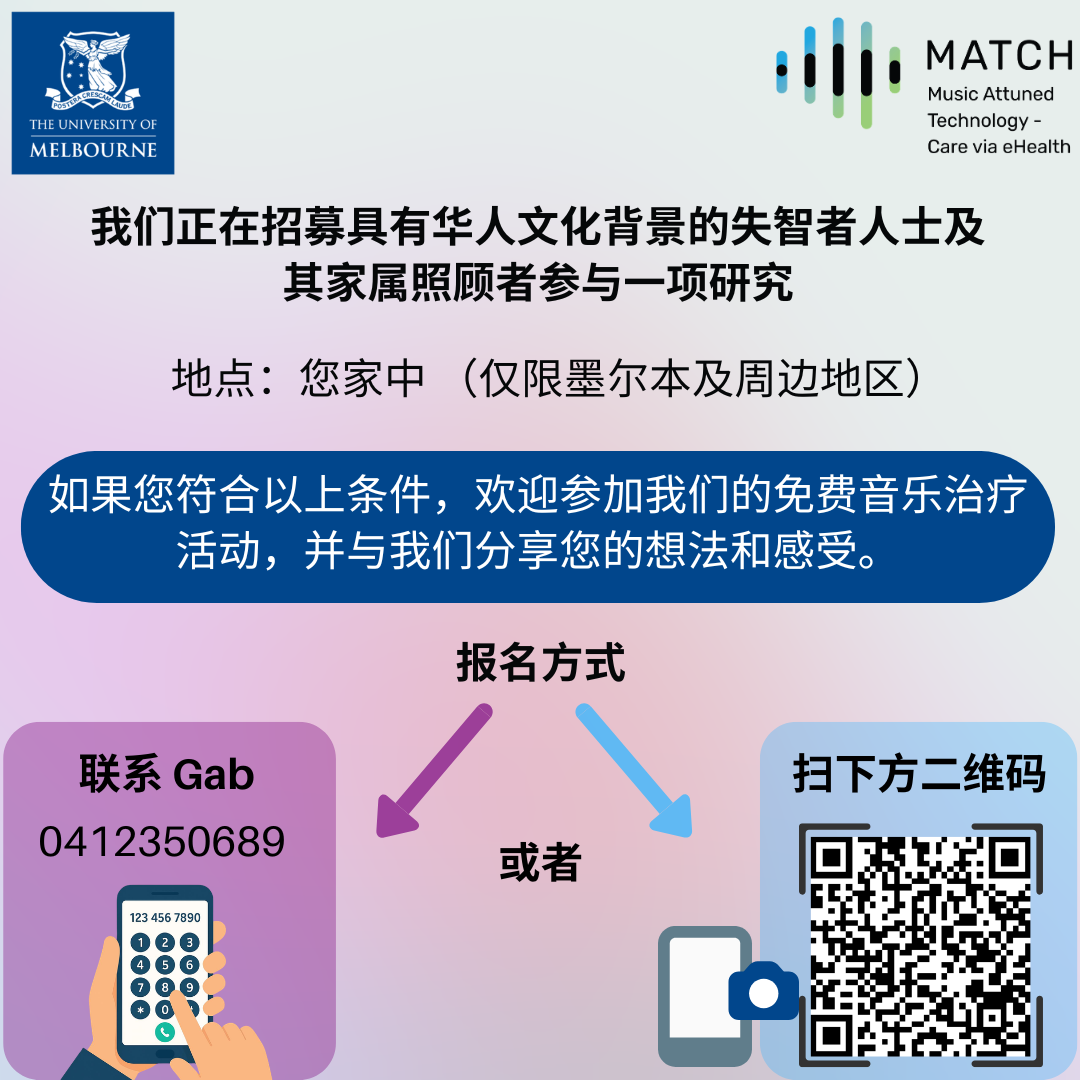
    A University of Melbourne study on dementia and music therapy is seeking participants from the Chinese and other culturally diverse communities.

    The study is looking for people living with dementia or cognitive decline, together with their family carers, to take part in a series of home-based music therapy sessions and share their experiences.

    The research aims to better understand how music therapy can support people from culturally diverse backgrounds and help ensure their voices are represented in dementia care research.

    To express your interest, please complete the form: https://q.surveys.unimelb.edu.au/jfe/form/SV_bvJs4kFZ6bbtXlI

    Contact: zhengyaog@student.unimelb.edu.au

    墨尔本大学一项关于失智症与音乐治疗的研究,现正招募华人社区及其他多元文化背景人士参与。

    研究对象为患有失智症或认知功能减退的人士及其家属照顾者。参与者将接受一系列上门音乐治疗服务,并分享相关体验与感受。

    本研究旨在深入了解音乐治疗如何更好地支持多元文化背景人士,并帮助确保他们的声音和经验能够在失智症照护研究中得到充分体现。

    如有兴趣参与,请填写报名表:https://q.surveys.unimelb.edu.au/jfe/form/SV_bvJs4kFZ6bbtXlI

    联系人: zhengyaog@student.unimelb.edu.au

  • Free Diabetes Information Sessions in Mandarin and Cantonese (免费中文糖尿病科普讲座)

    Free Diabetes Information Sessions in Mandarin and Cantonese (免费中文糖尿病科普讲座)

    Free Diabetes Information Sessions in Mandarin and Cantonese

    免费中文糖尿病科普讲座

    免费普通话糖尿病科普讲座

    免费广东话糖尿病科普讲座

    Hosted by Diabetes Victoria

  • CCCAV Pays Tribute to Russell Jack AM

    CCCAV Pays Tribute to Russell Jack AM

    CCCAV Pays Tribute to Russell Jack AM

    The Chinese Community Council of Australia (Victoria Chapter) acknowledges with sadness the passing of Russell Jack AM, a highly respected community leader whose lifelong commitment to preserving and promoting Chinese Australian heritage has left a significant and enduring legacy.

    Russell served the Bendigo Chinese Association for many decades, including as President, and played a leading role in the establishment and development of the Golden Dragon Museum. Through his vision and dedication, he helped ensure that the history, culture and contributions of Chinese Australians are recognised, preserved and shared with future generations.

    His commitment to community service, cultural preservation and intercultural understanding earned him widespread respect within the Chinese Australian community and across the broader Victorian community. In recognition of his contributions, he was appointed a Member of the Order of Australia in 1993.

    CCCAV extends its sincere condolences to the Jack family and to all who knew and worked with Russell during his long and distinguished life. His contribution to preserving and promoting Chinese Australian history and heritage will continue to be remembered and appreciated for many years to come.

    Ref: https://www.abc.net.au/news/2026-08-11/golden-dragon-museum-founder-russell-jack/107025350

  • Building Resilience: Workshop Successfully Held to Support International Students (增强韧性:支持留学生专题工作坊圆满举行)

    Building Resilience: Workshop Successfully Held to Support International Students (增强韧性:支持留学生专题工作坊圆满举行)

    Building Resilience: Workshop Successfully Held to Support International Students

    增强韧性:支持留学生专题工作坊圆满举行

    The Chinese Community Council of Australia, Victoria Chapter (CCCAV), Lifeline Australia, and the Centre for Contemporary Chinese Studies at the University of Melbourne successfully co-hosted Building Resilience: A Workshop for International Students on Friday 31 July 2026 at the University of Melbourne’s Arts West Building.

    The workshop attracted approximately 80 participants, bringing together international students, mental health professionals, community leaders and volunteers for an evening of learning, discussion and practical support. The event reflected a shared commitment by the three partner organisations to promote student wellbeing, strengthen resilience and encourage help-seeking within culturally diverse communities.

    The evening commenced with welcome remarks from Dr Qiuping Pan, followed by Abbivathana Deva of Lifeline Australia, who, as Master of Ceremonies, facilitated an engaging panel discussion featuring psychologists Maneesha Singh and Chenhong Xu.

    Maneesha Singh, a registered psychologist and founder of ManAsha Psychology, shared both her professional expertise and lived experience as a former international student and first-generation migrant. Drawing on more than 20 years of experience in mental health and community welfare, she discussed the importance of recognising emotional challenges early, overcoming stigma surrounding mental health, and creating culturally safe environments where individuals feel comfortable seeking support.

    Chenhong Xu, a registered clinical psychologist and founder of Mind Body Heart Psychology, spoke about the unique experiences faced by international students and migrants. She highlighted how language, culture, identity, family expectations and the migration journey can profoundly influence wellbeing and relationships. She also emphasised the value of culturally responsive mental health care, particularly for people navigating life in a new country.

    The moderated discussion explored many of the common challenges experienced by international students, including homesickness, academic pressure, loneliness, financial stress, cultural adjustment and balancing expectations from family and society. Participants were highly engaged throughout the session, contributing thoughtful questions and reflections during the Q&A segment.

    Following the panel discussion, participants took part in facilitated round-table conversations, where they shared personal experiences, discussed practical coping strategies and explored ways to strengthen social connections and community support. The discussions highlighted the importance of resilience, belonging and peer networks in promoting wellbeing.

    A key feature of the workshop was the introduction to Lifeline Australia’s Support Toolkit, presented by Abbivathana Deva and Varun Bharadwaj. The toolkit provides practical guidance on maintaining mental wellbeing, recognising signs of distress, supporting others and accessing professional assistance when needed. Participants also received mental health resources in English and Chinese, making it easier for international students from diverse cultural backgrounds to access wellbeing information and support services.

    The workshop concluded with participant reflections, feedback and discussions on future opportunities for collaboration. The strong attendance and active participation demonstrated the growing need for initiatives that create safe spaces for conversations about mental health, resilience and wellbeing among international students.

    CCCAV extends its sincere appreciation to Lifeline Australia, the Centre for Contemporary Chinese Studies at the University of Melbourne, the workshop speakers, volunteers, and all participants who contributed to the success of the event. Special thanks are also extended to the organising working group, who have been working together since the beginning of the year to plan and deliver this successful workshop: Abbivathana Deva, Varun Bharadwaj, Dr Qiuping Pan, Shuangming Huang and Dr Jimmy Li.

    The success of the workshop demonstrates what can be achieved when community organisations, mental health providers and educational institutions work together to support the wellbeing of international students. CCCAV looks forward to continuing partnerships that foster resilience, inclusion and meaningful community connections across Victoria’s multicultural communities.

  • Upcoming Exhibition: Connecting Memories Through Art (以艺术连接记忆)

    Upcoming Exhibition: Connecting Memories Through Art (以艺术连接记忆)

    Connecting Memories Through Art

    以艺术连接记忆 | 기억을 예술로 잇다

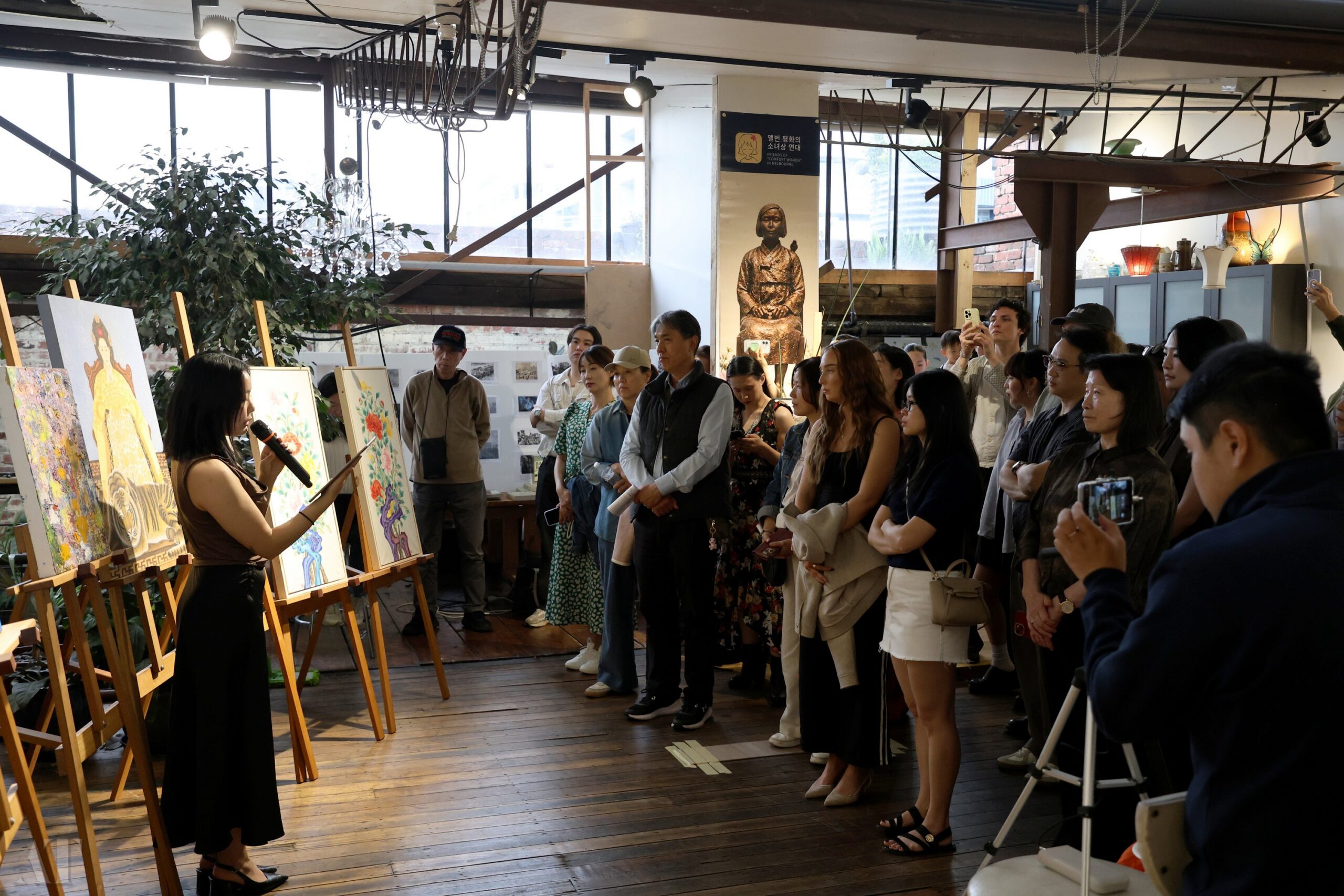
    Join us for Connecting Memories Through Art, an exhibition that brings together people from diverse backgrounds through the universal language of art, creating a space for reflection, dialogue, and mutual understanding. At the heart of the exhibition stands the Chinese Statue of Peace, symbolising the shared commitment of communities coming together in pursuit of justice, peace, and hope.

    While the issue of the “Comfort Women” has often been framed through the lens of controversy and political debate, we stand in solidarity in recognising it fundamentally as a human rights issue—one that calls for remembrance, dignity, and justice for survivors. By presenting the statue alongside artworks created by members of the community, the exhibition demonstrates the power of art to transcend differences, preserve memory, and inspire a collective commitment to human rights, compassion, and lasting peace.

    Call for Artists and Artwork Submissions

    The competition welcomes artists of all nationalities, cultural backgrounds and places of residence to submit original artworks responding to memory, dignity, human rights, peace and solidarity.

    Emerging artists, students, community artists and established artists are welcome to apply. Selected artworks will be exhibited alongside the Chinese Statue of Peace on 19 September 2026.

    For more information and to submit your artworks, please visit the website : https://connectingmemory.org/

    Chinese Australians for Peace Association & Friends of “Comfort Women” in Melbourne

  • Australian Census – 11 August 2026 (澳大利亚人口普查将于2026年8月11日举行)

    Australian Census – 11 August 2026 (澳大利亚人口普查将于2026年8月11日举行)

    Australian Census – 11 August 2026

    The 2026 Australian Census will take place on Tuesday, 11 August 2026. Census data helps governments, councils and community organisations plan essential services and better support our diverse communities.

    CCCAV encourages all community members to participate and ensure our multicultural communities are accurately represented. Every response counts.

    More information: https://info.census.abs.gov.au/about

    澳大利亚人口普查将于2026年8月11日举行

    关于人口普查

    澳大利亚统计局每五年会对澳大利亚境内的所有个人及住户进行统计。

    人口普查会了解多方面的信息,包括您的年龄、出生国家、文化背景、居住状况、工作和教育情况。

    人口普查提供的数据有助于规划医疗、交通、学校及基础设施。同时也用于规划面向个人、家庭与社区的本地服务。

    人口普查将于2026年8月11日星期二进行。

    哪些人需要参与

    在2026年8月11日星期二人口普查当晚,身处澳大利亚的每个人都必须包含在人口普查表格中。这包括:

    • 签证持有人
    • 国际访客
    • 国际留学生。

    人口普查不包括当晚不在澳大利亚境内的澳大利亚居民,也不包括居住在澳大利亚的外国外交官及其家属。

    您必须在表格中填报人口普查当晚在您住处过夜的所有人,包括访客和婴儿。根据《1905年人口普查和统计法》,参与人口普查是强制性的。您的个人信息受到法律保护,不会与任何第三方(含其他政府机构)共享。

    如何填写人口普查

    您可以通过在线填写、纸质表格填写,或在我们协助下填写人口普查。

    自2026年7月下旬起,各住户将陆续收到人口普查填写说明。如果您已确定人口普查当晚的所在地,收到说明后即可立即开始填写。

    如需使用您偏好的语言获得帮助,请致电翻译和口译服务(TIS National),电话 131 450。

    大多数住户会通过邮寄收到信件。信中包含您的16位人口普查编号和临时密码,用于在线填写人口普查。

    部分住户将直接收到纸质表格。填写完毕后,请使用随附的“邮资已付”信封寄回。如果您希望在线填写,表格上附有操作说明。

    对于入住酒店、汽车旅馆或学生公寓等住宿场所的国际访客与国际留学生,住宿工作人员将提供填写人口普查的说明。

    如果您希望与同住人员分开填写人口普查表格,可致电 1800 181 227 获取用于在线填写的普查编号,或申领一份英文纸质表格。

    您的信息如何得到保护

    您在人口普查表格中提供的个人信息受到法律保护,绝不会与任何其他方共享,包括内政部、澳大利亚税务局及 Centrelink 等其他政府机构。

    您在人口普查中提供的信息将予以保密。您的信息将得到妥善保管,我们不会以可能识别您身份的方式共享或公开有关您本人、您的家庭或住户的任何信息。

    您的数据受到《1988年隐私法》及《1905年人口普查和统计法》保密条款的保护。

    填写人口普查的协助

    如果您需要填写人口普查方面的协助,我们可以提供支持。

    • 人口普查表格仅提供英文版本。您可请家人或朋友协助填写。
    • 致电 1800 181 227,用英文与工作人员沟通。
    • 如需使用您偏好的语言获得帮助,请致电翻译和口译服务(TIS National),电话 131 450。
    • 您也可以使用我们的 “服务查询地图”(英文网页)查找您所在区域的协助服务。
    • 如果您未能找到所需语言的信息,请联系我们(英文网页)

    更多信息:https://info.census.abs.gov.au/language-support/simplified-chinese

  • Be AusAlert Ready – National Test on 27 July 2026 (澳大利亚全新紧急预警系统 AusAlert 即将于2026年7月27日开展全国测试)

    Be AusAlert Ready – National Test on 27 July 2026 (澳大利亚全新紧急预警系统 AusAlert 即将于2026年7月27日开展全国测试)

    Be AusAlert Ready – National Test on 27 July 2026

    澳大利亚全新紧急预警系统 AusAlert 即将于2026年7月27日开展全国测试

    Australia is introducing AusAlert, a new national warning system that uses the latest technology to send emergency alerts directly to compatible mobile devices. The system is designed to help keep people informed and better prepared during emergencies such as bushfires, floods, cyclones, severe weather events, public health emergencies, and other significant incidents.

    Before the official launch on 1 October 2026, a nationwide test will be conducted on Monday, 27 July 2026. In Victoria, New South Wales, Queensland, Tasmania and the ACT, a test Critical Alert will be sent at 2:00 pm (AEST). Residents may receive a message accompanied by a distinctive alert sound on compatible devices.

    The test is an important opportunity to ensure devices can receive alerts and to help the community become familiar with the new system. To learn more about AusAlert and check device compatibility, visit: https://www.ausalert.gov.au/

    澳大利亚政府即将推出全新的全国紧急预警系统 AusAlert。该系统利用最新技术,向兼容的手机和移动设备发送紧急警报,帮助公众在自然灾害和其他紧急事件发生时及时获取重要信息。AusAlert未来将用于发布有关山火、洪水、热带气旋、海啸、公共卫生事件及其他重大紧急情况的警报。

    在正式启用前,AusAlert将于 2026年7月27日(星期一) 进行全国测试。维多利亚州、新南威尔士州、昆士兰州、塔斯马尼亚州、首都领地的测试时间为 下午2:00(AEST)。届时,兼容设备可能会收到带有特殊提示音的测试警报。

    此次测试旨在帮助公众熟悉新的预警系统,同时验证设备是否能够正常接收警报。AusAlert预计将于 2026年10月1日 正式投入使用。

    建议大家提前了解相关信息,并确保手机系统保持更新,以便在未来紧急情况下及时收到重要通知。更多详情请访问:https://www.ausalert.gov.au/community-resources/languages/chinese-simplified

  • Upcoming Event: Building Resilience – A Workshop for International Students (欢迎参加: 增强韧性 – 留学生专题工作坊)

    Upcoming Event: Building Resilience – A Workshop for International Students (欢迎参加: 增强韧性 – 留学生专题工作坊)

    Upcoming Event: Building Resilience – A Workshop for International Students

    欢迎参加: 增强韧性 – 留学生专题工作坊

    Join us for an interactive workshop focused on mental wellbeing, resilience, and navigating the challenges of studying and living away from home. Two experienced wellbeing experts will share practical insights and strategies through a panel discussion, including an introduction to Lifeline’s Support Toolkit, a valuable collection of mental health and wellbeing resources designed to support individuals in everyday life. Participants will then take part in facilitated round-table discussions, providing an opportunity to connect with others, share experiences, and explore ways to build resilience and thrive both personally and professionally.

    This event is jointly hosted by the Chinese Community Council of Australia – Victoria Chapter (CCCAV), Centre for the Contemporary Chinese Studies and Lifeline, bringing together expert knowledge, practical resources, and community support to help international students build wellbeing, confidence, and meaningful connections.

    • Date: Friday 31 July 2026 4:30 PM for 5:00PM – 6:30 PM
    • Venue: University of Melbourne Arts West Building Room 256, 23 Professors Walk, Parkville Vic 3010 (near Parkville Train Station)

    Please RSVP: https://www.trybooking.com/events/landing/1611800

  • Opinion – On Australia’s Social Foundation: Multiculturalism with Shared Values and Vision (论澳洲的社会基石:共同价值,多元文化)

    Opinion – On Australia’s Social Foundation: Multiculturalism with Shared Values and Vision (论澳洲的社会基石:共同价值,多元文化)

    论澳洲的社会基石:共同价值,多元文化

    Dr. Blue Gum

    近年来,关于澳大利亚移民与多元文化政策的讨论从未停止。一国党领袖保琳·韩森(Pauline Hanson)曾公开宣称,澳大利亚不应执行多元文化政策,而应转向“单一文化(Monoculture)”。这种论调无论是否带有种族主义色彩,其底层逻辑都存在着严重的漏洞。韩森最大的思维盲区,在于完全混淆了“文明(Civilization)”与“文化(Culture)”这两个不同层面的概念。

    要厘清这个核心问题,首先必须明确文明与文化的本质区别。文化是生活层面的,具有极强的并行性与包容性。它涵盖了语言、习俗、宗教信仰、饮食以及艺术等多个方面。历史已经无数次证明,多元文化完全可以和谐共存。例如,犹太社区在欧洲和美国存在了数百年,他们始终保持着自己独特的文化特质、宗教传统与生活方式,但这并没有妨碍他们成为欧美社会中一个重要组成部分。

    相反,一个国家应该坚持的,是一个统一的文明,即统一的价值观。文明界定了人与人之间的关系,决定了人民的核心价值观。在澳大利亚,这个价值观表现为对自由民主的追求、对法治与契约精神的坚守、法律面前人人平等的原则,以及对“公平竞争(Fair Go)”这一社会契约的认同。无论移民来自何方,其原生文化如何,都必须在这个共同的文明与价值观框架内运作。

    韩森所担忧的社会撕裂,其实并非多元文化带来的,而是她未能区分这两者的边界。她误以为保持文化的多样性就会动摇国家的基石,因而鼓吹不切实际的“单一文化”。

    事实上,文化和语言的多元,绝不会妨碍个体对国家文明的认同与社会融合。在许多华人移民家庭中,父母和孩子在家用普通话或者自己的方言交流,这完全不妨碍他们用英语融入澳洲社会。特别是不少二代所具有的双语和双文化背景,不仅没有削弱他们的国民认同,反而赋予了他们服务澳洲社会的独特优势。

    澳大利亚是一个典型的移民国家,国家的繁荣与未来,依赖于持续吸纳优秀的、有能力的移民。客观而言,当前澳洲的经济结构依然极度依赖矿产资源,以及羊毛、海鲜、红酒等初级产品的出口。在过去几十年中,本土制造业几乎被抽空,自身高科技产业相对弱小,且缺乏一个完善的、类似硅谷模式的技术产业孵化机制。这导致了严重的人才流失, 不仅不少本土优秀人才被美国吸引,许多高层次的移民人才也选择回流母国。当前,世界正处于人工智能(AI)引领的技术革命浪潮中,澳洲
    在一定程度上已经显得有些落伍。如果不能迎头赶上,我们在未来将很难在全球竞争中占据领先位置。面对技术迭代与产业升级的严峻挑战,唯有依靠开放包容的软环境,才能在全球人才争夺战中胜出。因此,作为这个国家的一员,我们真正需要极力提倡和维护的,是一个共同的文明体系和核心价值观。在此基础之上,对多元文化给予充分的包容与鼓励,让不同族裔在和谐共存中求同存异,在共同发展中互利共赢。

    “共同价值,多元文化”,这才是顺应时代潮流、确保澳大利亚长治久安与持续繁荣的真正智慧。

    Opinion – On Australia’s Social Foundation: Multiculturalism with Shared Values and Vision

    In recent years, the debate surrounding Australia’s immigration and multicultural policies has remained unceasing. Pauline Hanson, the leader of One Nation, has publicly declared that Australia should abandon multiculturalism and pivot toward a “monoculture.” Regardless of whether this rhetoric carries racist undertones, its underlying logic suffers from severe flaws. Hanson’s greatest cognitive blind spot lies in her complete conflation of two distinct concepts: “civilization” and “culture.”

    To clarify this core issue, one must first recognize the fundamental difference between civilization and culture. Culture operates at the level of daily life, possessing an immense capacity for coexistence and inclusivity. It encompasses various aspects, including language, customs, religious beliefs, cuisine, and the arts. History has proven time and again that diverse cultures can coexist in perfect harmony. For instance, Jewish communities have existed in Europe and the United States for centuries; they have consistently maintained their unique cultural identity, religious traditions, and way of life, yet this has never prevented them from becoming an integral part of Western society.

    Conversely, what a nation must adhere to is a unified civilization, namely, a shared framework of core values. Civilization defines the relationship between individuals and determines the core values of its people. In Australia, these values manifest as the pursuit of liberal democracy, a steadfast commitment to the rule of law and the spirit of contract, the principle of equality before the law, and an allegiance to the social contract of a “Fair Go.” Regardless of where immigrants come from or what their native culture may be, they must operate within this shared framework of civilization and values.

    The social fragmentation that Hanson fears is not, in fact, caused by multiculturalism, but rather by her failure to distinguish the boundaries between these two concepts. Mistakenly believing that maintaining cultural diversity would shake the nation’s foundations, she advocates for an impractical and detrimental “monoculture.”

    In reality, cultural and linguistic diversity by no means hinders an individual’s identification with the national civilization or their social integration. According to my own observation, in many Chinese immigrant families, parents and children speak Mandarin or their own dialects at home, yet this does not impede them from using English to integrate into broader Australian society. In particular, the bilingual and bicultural backgrounds of many second-generation immigrants, far from weakening their national identity, grant them a unique advantage in serving the Australian community.

    Australia is a quintessential immigrant nation, whose prosperity and future depend on the continuous recruitment of talented and capable immigrants. Objectively speaking, Australia’s current economic structure remains heavily reliant on mineral resources and the export of primary commodities such as wool, seafood, and wine. Over the past few decades, domestic manufacturing has been virtually hollowed out, the homegrown high-tech sector remains weak, and the country lacks a mature, Silicon Valley-style incubator mechanism for technological industries. This has led to a severe brain drain, not only are many top local talents lured to the United States, but many high-level immigrant talents have also chosen to return to their home countries. As the world undergoes a technological revolution driven by Artificial Intelligence (AI), Australia has fallen somewhat behind. If we fail to catch up, it will be exceedingly difficult to secure a leading position in the future global landscape. Faced with the harsh challenges of technological iteration and industrial upgrading, Australia can only triumph in the global war for talent by relying on an open and inclusive soft environment. Therefore, as members of this nation, what we truly need to champion and safeguard is a shared civilizational framework and core values. Upon this foundation, we must offer full tolerance and encouragement to multiculturalism, allowing different ethnic groups to seek common ground while reserving differences in harmonious coexistence, and to achieve mutual benefit in collective development.

    Multiculturalism with Shared Values and Vision, this is the true wisdom required to align with the trends of the times and to ensure Australia’s long-term peace, stability, and enduring prosperity.


  • Disability Gateway : Connecting People with Disability to Services and Support | Disability Gateway : 帮助残障人士找到所需服务与支持

    Disability Gateway : Connecting People with Disability to Services and Support | Disability Gateway : 帮助残障人士找到所需服务与支持

    Disability Gateway : Connecting People with Disability to Services and Support (Disability Gateway : 帮助残障人士找到所需服务与支持)

    为自己、家人或亲友找到合适的支持服务,有助于每个人过上健康、独立的生活。

    Disability Gateway 让您更容易找到这些支持服务。这是一个免费的电话和网
    站服务,可帮助您获取所在地区的信息和服务。